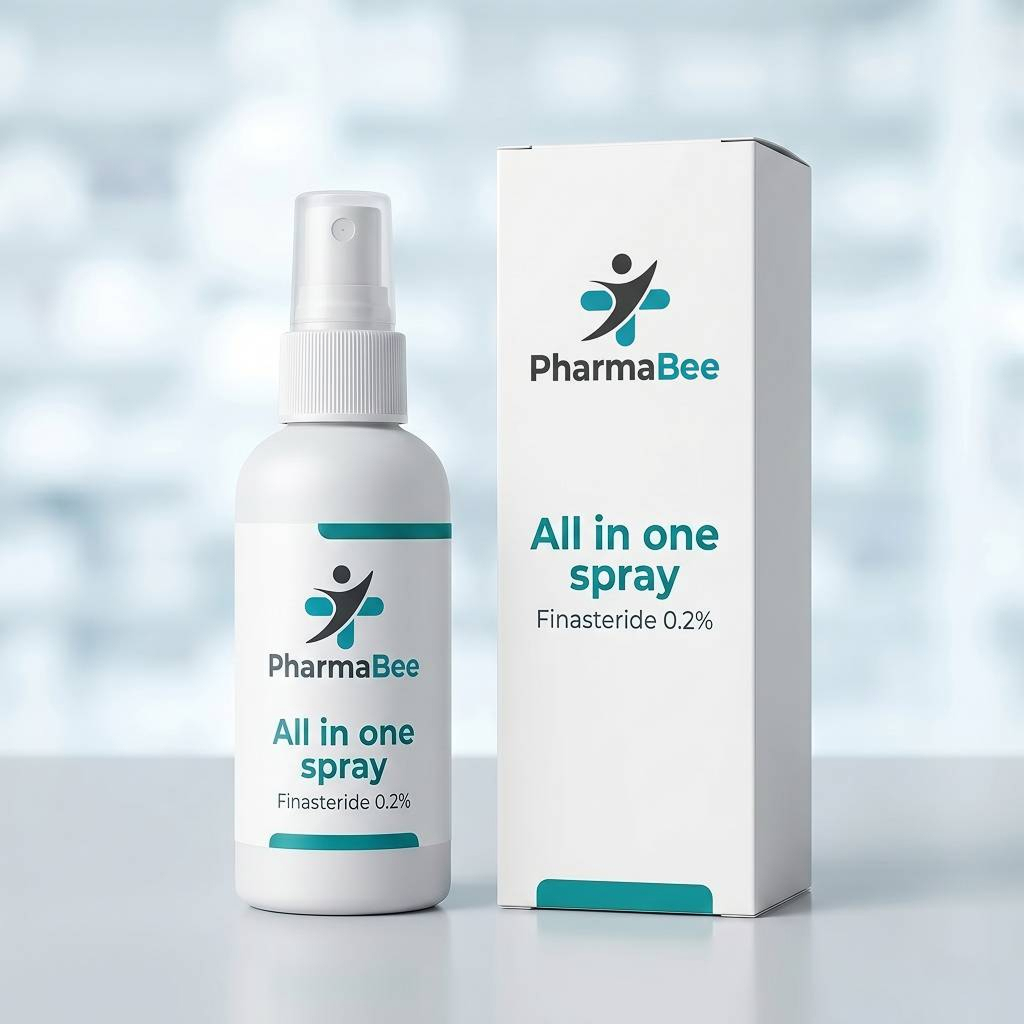
Finasteride 0.2% topical spray delivers Finasteride directly to the scalp, targeting DHT at follicle level while reducing the risk of systemic side effects compared to oral tablets.
Applied once daily to the scalp. Suitable for men who want to address hair loss while minimising the systemic side effects associated with oral Finasteride.

| Quantity | 60ml (1 month supply), 120ml (2 months supply), 180ml (3 months supply) |
|---|
What is Finasteride 0.2% Topical Spray?
Finasteride 0.2% spray is a compounded topical formulation off-label for male pattern hair loss. Unlike the oral tablet, it acts locally at the scalp, reducing DHT in the follicles with lower systemic absorption. It is an unlicensed medicine where clinically appropriate by a UK-registered specialist.
How does it work?
Finasteride inhibits 5-alpha reductase, reducing the conversion of testosterone into DHT. Applied to the scalp, it acts locally at the hair follicle, promoting follicle recovery and healthier hair growth, with less impact on DHT levels throughout the rest of the body than oral Finasteride.
Topical vs Oral Finasteride — Key Differences
How to use
Apply to dry scalp in affected areas once daily, usually in the evening. Part the hair, apply evenly, allow to dry before styling. Wash hands after use.
How long does it take to work?
Stabilisation of hair loss is typically noticed within 3–6 months of continuous daily use, with peak benefit at 2 years. Treatment must be maintained every day — stopping will lead to reversal of benefits within 9–12 months.
Who should not use this?
Pregnancy warning
If your partner is pregnant, they must not handle the spray or contact treated areas until dry. Use condoms during treatment as traces of Finasteride may be present in semen.
Q: Is the spray as effective as the tablet?
A: Clinical studies support topical Finasteride for hair loss. It targets DHT locally at the scalp. Systemic DHT suppression is lower than with oral tablets, which may be preferable for those concerned about systemic side effects.
Q: Is this a licensed medicine?
A: Finasteride 0.2% spray is an unlicensed (special-order) medicine off-label by a our team where clinically appropriate.
Q: How long before I see results?
A: Most men notice stabilisation of hair loss within 3–6 months of daily use, with peak results typically at 2 years.
Q: How do I apply it?
A: Apply to dry scalp in affected areas once daily. Part the hair, spray directly onto scalp, allow to dry before styling, and wash hands after application.
Q: What if my partner is pregnant?
A: Pregnant women must not handle the spray or contact treated areas until dry. Use condoms throughout treatment.
As an unlicensed medicine, the side effect profile is still developing. It is likely similar to oral Finasteride but with reduced frequency due to lower systemic absorption. Side effects are uncommon but can include:
Important side effects to be aware of:
Side effects can persist after stopping treatment in some cases. Any new or unusual symptoms should be raised with your GP.

Mulla Pharm Limited, 1 Haverflatts Lane, Milnthorpe, Cumbria, LA7 7PS
Copyright © 2026 Mulla Pharm Limited, All Rights Reserved. Company Registration No: 07821735 Website by Arise Digital